We moved in this house around August 2010. Finally, 3 years later, we got around to tearing down the walls in the laundry room to add insulation. Wow, what a mess! Not sure when this room was added on or worked on after but the walls were very random. I believe this room was a porch at one point and then enclosed. The ceiling is slanted which wasn't easy for a novice to work with, but to make it worse, the floor is uneven and the door frame is kinda cock-eyed.
But, we finally did it, well mostly. The door still needs some tweaking, but that will be saved for another day, the wind doesn't blow in the room and I'm happy about just that. There were boards and pieces of boards nailed into the 2x4s.
There was also plenty of nests inside the walls where parts were not sealed.
The weights, ropes and pulleys were dusty but in good shape.
But blah blah blah, we finished! I love the stripes behind the washer/dryer, don't you?
My laundry basket used to be my now wall color so it had to be painted too, looks great yellow, right?
No real decor in here when I took pics, but here is the dining room side
The dog door is on the east side of the house now, MUCH better.
I even created and hung a new light fixture.
So that completes the tour of my Laundry/Dining Room, next up is the Guest Room and the Wizard will have a new home!
Oh! I almost forgot, and people always ask, my "blue" for my room is by Valspar (the only paint I use) and it's called Aqua Dance.
Showing posts with label history. Show all posts
Wednesday, October 23, 2013
Sunday, November 14, 2010
The New Chandy
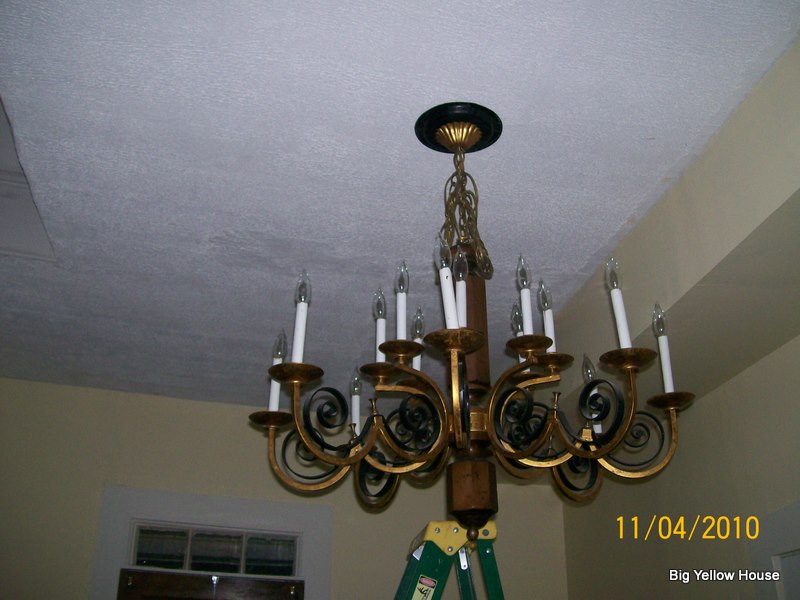
This is the chandy that was previously in my entry hall. One of the previous owners claimed they bought it from an antique store. And while it is a great light, I thought it was way too small for my entry hall, and one of the lights didn't even work.
I can't remember the square footage of my entry hall, but I do remember it is much larger than my kitchen.
This is the one we bought at ReStore for the bargain price of $25! It is HUGE! And it is also very heavy. I'm so not a fan of gold or brass and had design to paint it. But since I haven't figured out the other colors in there yet (more on that later), it got hung as is for now.
The old one came down, but since they didn't hang it from a stud (ugh) we (he) had to make a bigger hole since the new one was much heavier.
We had company, they (he) helped. They reinforced it.
And then it got hung up and they called us women folk into the entry hall to check it out. They thought it would be funny to hang it "my size" so I could easily change the bulbs. Mr. Company is demonstrating the shortness of it all. HA!
Back to business.........it works! But Oh Em Gee it's bright! You think 40 watt was a bit too much? LOL I can now operate in that room! We still had the business of the new hole in the ceiling though and without a cover around, we needed something quick! Mrs. Company (knowing my love of repurposing AND spray painting) suggested a paper plate! Genius!
I thought about NOT sharing that part, but really, in a pinch? That is genius! No one even knows what it is all hung up there pretty like.
See? And it looks oh so fabulous in there! We are thinking of getting a dimmer switch to tone it down a bit because I'm thinking even the 20 watt bulbs are going to be a bit much if you aren't operating!
Back to the business of color.......See that floor? It's fabric. I guess back in the day some of the more affluent people covered their floors in fabric to prevent drafts. They just painted them, saturate them is the instruction I got from a previous owner that recreated this look. It's currently caramel color.
The walls are kind of a sunny yellow color. It is NOT what I wanted but I was frustrated and moved on to another project at this point. You can see what I was wanting HERE.
My house consist mostly of the colors in this pitcher. The entry hall leads into this sun room whose floor is another problem child of mine. WHY PAINT WOOD FLOORS? *ugh*
This is actually the way the sun room looks now. But anyway...........if anyone has any advice or suggestions on what to do with these two floors, painting or otherwise, please feel free to chime in!
I can't remember the square footage of my entry hall, but I do remember it is much larger than my kitchen.
This is the one we bought at ReStore for the bargain price of $25! It is HUGE! And it is also very heavy. I'm so not a fan of gold or brass and had design to paint it. But since I haven't figured out the other colors in there yet (more on that later), it got hung as is for now.
The old one came down, but since they didn't hang it from a stud (ugh) we (he) had to make a bigger hole since the new one was much heavier.
We had company, they (he) helped. They reinforced it.
And then it got hung up and they called us women folk into the entry hall to check it out. They thought it would be funny to hang it "my size" so I could easily change the bulbs. Mr. Company is demonstrating the shortness of it all. HA!
Back to business.........it works! But Oh Em Gee it's bright! You think 40 watt was a bit too much? LOL I can now operate in that room! We still had the business of the new hole in the ceiling though and without a cover around, we needed something quick! Mrs. Company (knowing my love of repurposing AND spray painting) suggested a paper plate! Genius!
I thought about NOT sharing that part, but really, in a pinch? That is genius! No one even knows what it is all hung up there pretty like.
See? And it looks oh so fabulous in there! We are thinking of getting a dimmer switch to tone it down a bit because I'm thinking even the 20 watt bulbs are going to be a bit much if you aren't operating!
Back to the business of color.......See that floor? It's fabric. I guess back in the day some of the more affluent people covered their floors in fabric to prevent drafts. They just painted them, saturate them is the instruction I got from a previous owner that recreated this look. It's currently caramel color.
The walls are kind of a sunny yellow color. It is NOT what I wanted but I was frustrated and moved on to another project at this point. You can see what I was wanting HERE.
My house consist mostly of the colors in this pitcher. The entry hall leads into this sun room whose floor is another problem child of mine. WHY PAINT WOOD FLOORS? *ugh*
This is actually the way the sun room looks now. But anyway...........if anyone has any advice or suggestions on what to do with these two floors, painting or otherwise, please feel free to chime in!
Tuesday, September 14, 2010
The Nowlin House
I met a wonderful man who happens to be the superintendent in the school here. He stopped by to check on my son's bus schedule. Yes, stopped by the house, who does that?
He also happens to be a previous owner of the house and loves history. He wrote a paper on the house and this is it.
For over 100 years the two story frame house was known as the Nowlin House. Built in 1853 by storekeeper James Reed, then sold to another storekeeper, Bryan W. Nowlin shortly afterward, the house was given to Bryan's son, Sam Nowlin, in 1859 when Sam turned 21. Sam was born August 18, 1838.
Sam married Sarah Peery of Howard County on June 30 of 1861. They had two children, Thomas and Sarah. Mrs. Nowlin died on December 27, 1864. Sam went off to the Civil War in September of 1861 as a Southern cavalryman. He served his enlistment of seven months with the Missouri State Guard, became a Captain and Adjutant under Colonel Gideon W. Thompson, fought in the Battles of Lexington, Missouri and Pea Ridge, Arkansas. He returned home after being discharged at Van Buren, Arkansas on March 16, 1862.
He tried to live in peace and entered the grocery business with his father. But he and his father were arrested in April and were taken to the county seat in Liberty where they were made to post a $5,000 bond and take the loyalty oath by Colonel Penick due to their southern leanings. Colonel W.R. Penick and 500 Federal troops (Missouri Militia, 5th Missouri Cavalry) had been sent from St. Joseph to Liberty to occupy the town and root out the guerrilla fighters who were emerging in Clay County. Two others who had to post bond in the spring of 1862 were future guerrilla soldiers Frank James, brother of Jesse James, and Colonel Gideon W. Thompson, Sam Nowlin's former commander in the Missouri State Guard. They had also left the army hoping to live in peace.
Thompson didn't keep his oath and went "back out" where he used his commission to swear Charles Quantril and Cole Younger into the Confederate Army under the Partisan Ranger Act. Sam chose to stay close to home. But the war came back to him. On May 19, 1863 Frank James and 11 others rode into town as Southern guerrillas, killed the Captain of the U.S. Militia, Darius Sessions, Lt. Grafenstein and all the enlisted men present except one, who survived his wounds.
The guerrillas "broke into" James Reed's store, "forced open the safe, took $180 in gold, and destroyed all his valuable papers and other property."
Nearby they merely "plundered" Nowlin's store, did "considerable damage," and "charged about in a threatening manner." Actually, they came to the Nowlin store to get cigars and tobacco to celebrate killing Sessions for arresting Mrs. Lurena McCoy because she would not tell the whereabouts of her Confederate husband, Captain Moses McCoy. The Nowlins asked them to make it look like a robbery so they wouldn't lose their bond money. Frank James had served in battle with Sam Nowlin at Lexington. Bryan Nowlin had been in business with Darius Sessions in 1854, but dissolved that business in 1856. Sessions had become an outspoken abolitionist.
In January of 1864 "jayhawkers" from Kansas robbed the Nowlin store of $2,000 worth of goods. Eventually the war ended in 1865 and the Nowlins got to live in peace. Sam's Colonel, Gideon Thompson, was brought to Federal Court in November of 1865 and was stripped of all his property for his role in the rebellion. The Nowlin's got their bond back.
The "Nowlin Store Building", as it was described in a newspaper ad, was sold in 1869 and became the Missouri City Savings Bank. Sam took up farming and Bryan Nowlin moved to Prathersville. The building is now on the National Register of Historic Places.
Sam's wife had died in 1864 but he married again, eventually having 7 children, descendents of whom owned the house until 1946.
Joe Fancher bought it, then left it to his son, Fred Fancher, who owned it until his death in 1979. After that the Henley's, then the McCaulley's owned it. In August of 2004 it was purchased by Jay Jackson for the purpose of renovation and preparation for the next 100 years.
The original house was two story, 18 by 30 feet made of native oak and walnut. It has had several additions and is now 2200 square feet with three bedrooms, two and a half baths, fireplace, two enclosed sun rooms, a garage and workshop, two basements, new central air, heat pump, underground electricity, new wiring, new plumbing, new roof, new carpet, three refinished hardwood floors, a painted canvas entryway, and a modern kitchen.
Written by Jay Jackson
revised August 28, 2010
Isn't that all fabulous information? It does leave me hanging for more and more though. He has promised me more history and I'm an eager learner.
He also happens to be a previous owner of the house and loves history. He wrote a paper on the house and this is it.
For over 100 years the two story frame house was known as the Nowlin House. Built in 1853 by storekeeper James Reed, then sold to another storekeeper, Bryan W. Nowlin shortly afterward, the house was given to Bryan's son, Sam Nowlin, in 1859 when Sam turned 21. Sam was born August 18, 1838.
Sam married Sarah Peery of Howard County on June 30 of 1861. They had two children, Thomas and Sarah. Mrs. Nowlin died on December 27, 1864. Sam went off to the Civil War in September of 1861 as a Southern cavalryman. He served his enlistment of seven months with the Missouri State Guard, became a Captain and Adjutant under Colonel Gideon W. Thompson, fought in the Battles of Lexington, Missouri and Pea Ridge, Arkansas. He returned home after being discharged at Van Buren, Arkansas on March 16, 1862.
He tried to live in peace and entered the grocery business with his father. But he and his father were arrested in April and were taken to the county seat in Liberty where they were made to post a $5,000 bond and take the loyalty oath by Colonel Penick due to their southern leanings. Colonel W.R. Penick and 500 Federal troops (Missouri Militia, 5th Missouri Cavalry) had been sent from St. Joseph to Liberty to occupy the town and root out the guerrilla fighters who were emerging in Clay County. Two others who had to post bond in the spring of 1862 were future guerrilla soldiers Frank James, brother of Jesse James, and Colonel Gideon W. Thompson, Sam Nowlin's former commander in the Missouri State Guard. They had also left the army hoping to live in peace.
Thompson didn't keep his oath and went "back out" where he used his commission to swear Charles Quantril and Cole Younger into the Confederate Army under the Partisan Ranger Act. Sam chose to stay close to home. But the war came back to him. On May 19, 1863 Frank James and 11 others rode into town as Southern guerrillas, killed the Captain of the U.S. Militia, Darius Sessions, Lt. Grafenstein and all the enlisted men present except one, who survived his wounds.
The guerrillas "broke into" James Reed's store, "forced open the safe, took $180 in gold, and destroyed all his valuable papers and other property."
Nearby they merely "plundered" Nowlin's store, did "considerable damage," and "charged about in a threatening manner." Actually, they came to the Nowlin store to get cigars and tobacco to celebrate killing Sessions for arresting Mrs. Lurena McCoy because she would not tell the whereabouts of her Confederate husband, Captain Moses McCoy. The Nowlins asked them to make it look like a robbery so they wouldn't lose their bond money. Frank James had served in battle with Sam Nowlin at Lexington. Bryan Nowlin had been in business with Darius Sessions in 1854, but dissolved that business in 1856. Sessions had become an outspoken abolitionist.
In January of 1864 "jayhawkers" from Kansas robbed the Nowlin store of $2,000 worth of goods. Eventually the war ended in 1865 and the Nowlins got to live in peace. Sam's Colonel, Gideon Thompson, was brought to Federal Court in November of 1865 and was stripped of all his property for his role in the rebellion. The Nowlin's got their bond back.
The "Nowlin Store Building", as it was described in a newspaper ad, was sold in 1869 and became the Missouri City Savings Bank. Sam took up farming and Bryan Nowlin moved to Prathersville. The building is now on the National Register of Historic Places.
Sam's wife had died in 1864 but he married again, eventually having 7 children, descendents of whom owned the house until 1946.
Joe Fancher bought it, then left it to his son, Fred Fancher, who owned it until his death in 1979. After that the Henley's, then the McCaulley's owned it. In August of 2004 it was purchased by Jay Jackson for the purpose of renovation and preparation for the next 100 years.
The original house was two story, 18 by 30 feet made of native oak and walnut. It has had several additions and is now 2200 square feet with three bedrooms, two and a half baths, fireplace, two enclosed sun rooms, a garage and workshop, two basements, new central air, heat pump, underground electricity, new wiring, new plumbing, new roof, new carpet, three refinished hardwood floors, a painted canvas entryway, and a modern kitchen.
Written by Jay Jackson
revised August 28, 2010
Isn't that all fabulous information? It does leave me hanging for more and more though. He has promised me more history and I'm an eager learner.
Friday, August 20, 2010
Where is the mailbox?
Why, it's right here in our local post office!
While this is certainly not the smallest post office I've ever seen, it is one of the smallest.
When we went in to get our PO Box, John the postmaster was working on his last day and looking forward to retirement. But in the few minutes we were inside filling out paperwork, he managed to fill us in on some of the town, the workings of the post office, and introduced us to our new neighbors that came in to check their mail.
There are four parking spaces, and one of those is handicapped, the other is where the postmaster parks. So that leaves two. I think of going to the post office previously and thinking the twenty or more spaces they had weren't enough, lol. But no matter when I go, there is always room.
It has been suggested that we should have a mailbox though, if only for looks. I believe I saw one of our neighbors with one, but didn't really pay attention to it.
While this is certainly not the smallest post office I've ever seen, it is one of the smallest.
When we went in to get our PO Box, John the postmaster was working on his last day and looking forward to retirement. But in the few minutes we were inside filling out paperwork, he managed to fill us in on some of the town, the workings of the post office, and introduced us to our new neighbors that came in to check their mail.
There are four parking spaces, and one of those is handicapped, the other is where the postmaster parks. So that leaves two. I think of going to the post office previously and thinking the twenty or more spaces they had weren't enough, lol. But no matter when I go, there is always room.
It has been suggested that we should have a mailbox though, if only for looks. I believe I saw one of our neighbors with one, but didn't really pay attention to it.
Monday, August 16, 2010
Doorknobs
Our home has doorknobs on the side door and back door and the toilet closet, and that's about it, lol. I'm not sure what happened to them all, but they are gone. Some of the doors we can use the skeleton keys on, but mostly you just don't want to shut a door unless you walk around to push it open again. I would like to keep the knobs period specific so I'm on the hunt for doorknobs.
We went to the cutest little hardware store yesterday. You know, the ones with wood floors stuffed from floor to ceiling with hardware, gifts and what nots? They have some glass knobs like I currently have now in my 1920 home. Not sure if that was period specific or not, I knew I had more research to do.
It seems glass doorknobs date back to 1826, when the process for pressing molten glass into molds was invented, but they didn't become popular until after the United States entered World War I, in 1917. Cast brass, bronze, and iron doorknobs, which had dominated the hardware market since the beginning of the Victorian era in 1860, were in short supply because metals were needed for airplanes and ammunition.
So was it glass or brass?
I finally found the answer here which states "The influence of the Greek Revival of the early to mid-1800’s is evident in the fun and fancy Meadows pattern. The beaded details blend well with mouldings, wall coverings, and home furnishings."
Now, if I can just remember to count how many I need..........
We went to the cutest little hardware store yesterday. You know, the ones with wood floors stuffed from floor to ceiling with hardware, gifts and what nots? They have some glass knobs like I currently have now in my 1920 home. Not sure if that was period specific or not, I knew I had more research to do.
It seems glass doorknobs date back to 1826, when the process for pressing molten glass into molds was invented, but they didn't become popular until after the United States entered World War I, in 1917. Cast brass, bronze, and iron doorknobs, which had dominated the hardware market since the beginning of the Victorian era in 1860, were in short supply because metals were needed for airplanes and ammunition.
So was it glass or brass?
I finally found the answer here which states "The influence of the Greek Revival of the early to mid-1800’s is evident in the fun and fancy Meadows pattern. The beaded details blend well with mouldings, wall coverings, and home furnishings."
Now, if I can just remember to count how many I need..........
Well what is it?
It is a 2 story 2034 square feet home with a 26,550 square foot lot. It has 3 bedrooms and 2 1/2 baths with a partial stone basement. It has what they are calling a detached 1 car garage. I call it a shed with a drive thru, he calls it a man cave.
The sign on the front suggests it's an 1853 home, although we bought it as an 1860 home. I haven't gotten the answer yet on which one is correct.
I have done a lot of research on the style of home it is though. Keeping it as period specific as I can is very important to me. This is what I've found.
Greek Revival houses usually have these features:
* Pedimented gable
* Symmetrical shape
* Heavy cornice
* Wide, plain frieze
* Bold, simple moldings
Many Greek Revival houses also have these features:
* Entry porch with columns
* Decorative pilasters
* Narrow windows around front door
The windows lined up represent columns. Greek Revival was coming to an end in the 1850s and moving toward its cornice-heavy younger cousin, the Italianate. I think that's why it's hard for me to figure out what my house is. I do believe it's Greek Revival though. Of course there were a lot more elaborate Greek revivals.
This is an example of a greek revival home. Ours is very similar.
In this picture, you can see the cornice above the window, and you can also see where they removed the wide plain frieze. The wide plain frieze is still intact on one of the upper windows. Some of the windows were obviously replaced. There are no storm windows or screens anywhere in the house. We plan on building our own wooden screens :)
You can see the pedimented gable over the portico. It's hard to say if it had any pilasters or not, but I could imagine them being there around the doorway, and may just put some in.
It seems the shutters are optional. After we replace the frieze and paint the cornice, frieze and windows a COLOR, then we can decide if we want them or not.
I still don't know whom the house was built for or it's history, I just need more research time. But it sure is fun!
Welcome Home
Population of 295 just grew to 298.
Townie: Where do you live?
Us: The Big Yellow House
The neighbors have been very welcoming to us. They have been very generous in telling us stories about our home, it's previous owners, the town, and other neighbors. Let the journey begin.
Townie: Where do you live?
Us: The Big Yellow House
The neighbors have been very welcoming to us. They have been very generous in telling us stories about our home, it's previous owners, the town, and other neighbors. Let the journey begin.
Subscribe to:
Comments (Atom)